Sunday, November 11, 2012

Office Guilt

I call this my "WKCE Cave"
We've just completed state testing in Wisconsin, but that doesn't mean I'm done yet.  I've hardly been in classrooms the past 2 weeks due to testing (as the District Assessment Coordinator I organize testing for MS/HS too), but now I still have make-up testing and then the time consuming task of getting the tests ready to ship back. 

Among all of this, I have realized that I never scheduled my #NoOfficeDay.  My point of #NoOfficeDay was to not only be in classrooms, but to also be a part of teaching in classrooms.  Unfortunately, with testing and everything else to do I've hardly been in classrooms at all and it gives me tremendous office guilt.
As a teacher, I never did any sort of my own work whenever there were students in the classroom, because my time with them was precious. I took this mentality with me to my role as principal and always feel like I should be out of the office during the time that students/teachers are in the building.  As much as I love that mentality, it's just not reality with the amount of paperwork that we have to do as principals.  As much as I try to focus on people during the school day and paperwork at night, that mentality would mean midnight every night for me to catch up and I would still never catch up. I have learned this is not healthy (believe me, I've tried it!).

My office guilt is a wake-up call for me to put what I've learned from Getting Things Done and other tips learned from my GTD Gurr Admin Colleagues (Curt and Justin) back into practice that I have been letting slip as the state tests took over my life. This starts with scheduling everything in advance...blocking out big chunks of time in my calendar for classroom time (this time also includes for conversations with teachers) and blocking out office time.  When I schedule the office time, I also need to schedule what I need to accomplish during those times.  I've been pretty good at utilizing my "Tickler file", however, I have been just moving stuff from day to day, not actually accomplishing much from each folder.  I am also going to think about my "open door policy" after reflecting on this post by Scott Elias.   


Finally, for my sanity, this post got me to turn off my technology for 2 Saturdays in a row. (I know... this is hard to believe that I actually did it, but I swear I did and it was WONDERFUL!!)

Sunday, November 4, 2012

Encouraging a growth mindset

Here's a cross-post from my staff memo blog...


Last school year I learned a great deal from the book Mindset, by Carol Dweck and shared my learning with you in this post. I don't know if anyone else also read this book, but I am starting to notice a lot of classroom practices and teachers talking in ways to encourage students to have a growth mindset versus a fixed mindset. 

In one classroom, students were discussing the following quote: "We all make mistakes. That's why a pencil has an eraser."  I've been lucky enough to get into several classrooms during the math talk time to hear students explain their thinking or to see students writing to "Puzzled Penguin" to tell him what math mistake he made.

In another classroom during science stations, students were told "Don't worry if you get it wrong, just try to think of what it might be and then check to see if you're right. Think about the new things you're learning."  At the end of this class period, students' exit slips included listing 3 new things they learned.  What was most amazing to me is throughout this class period, one student stood out to me as the model reason of why we need to encourage students to have a growth mindset.  During an iPad quiz, I watched this student answer questions as quickly as possible and when she got them wrong, moved on without even paying attention to what the correct answer was so she could learn from it.  When she moved on to a partner quiz with student-made notecards, she was proud to share that she had 15 right and only 5 wrong. When I asked her what she learned from the 5 wrong she said, "oh, I guess I should look at them."  At the end of the class period when students were given the exit slips on 3 new things they learned, everyone started writing, but this student said, "I didn't learn anything new."

The teacher did everything she could to encourage students to focus on what new things they were learning, however, this particular student has already become so used to focusing on getting the right answers, that she hasn't learned how to learn from the wrong answers.  She was my "aha moment" of why we need to continue our work on helping our students to become passionate about learning, develop a growth mindset, and learn from mistakes.

If you're looking for great posters/quotes on this topic, I found great ones from Krissy Venosdale.  Here are some of my favorites:


Wednesday, October 3, 2012

Do my teachers know how amazing they are?

Our school is fortunate to have so many amazing educators, but I recently shared with one of my teachers that I wanted to nominate her for a teaching award in our state.  To complete this nomination process, a teacher must be nominated, but then needs to turn in recommendation letters and write an essay.  Because there would be work on her part, I asked her if she would let me nominate her and gave her time to think about it (I did say I could easily get those recommendation letters).  She was honored at my thought to recognize her, but didn't feel she was a viable candidate for the award.

At first I was amazed at her humility, but as I thought more about it I became more reflective of myself.  How can an amazing teacher not realize how amazing she is and why haven't I let her know she's award-worthy before? I have many teachers that I could say the same about...would they be thinking the same thing if I asked each of them?  How can I do a better job as the principal and lead-learner to let my teachers know how amazing they are?

I have written in several posts how I strive to give coaching feedback to my teachers as often as possible, which is a struggle with everything a principal has to do on a daily basis. I try to highlight the positive things that I see each and every day, but what else can I do to fill my teachers' buckets? ("bucket filling" is our school theme this year). How can I do a better job of letting my teachers know that they matter?  I'm going to make a new personal goal to start out each day by writing a positive note to a staff member. I would love to hear what other principals do?

What a better way to end this thought than with Angela Maier's You Matter Manifesto?


Thursday, September 20, 2012

Why We Love #NoOfficeDay


Why We Love #NoOfficeDay
This blog post was co-written by Shira Leibowitz, William King, and Myself

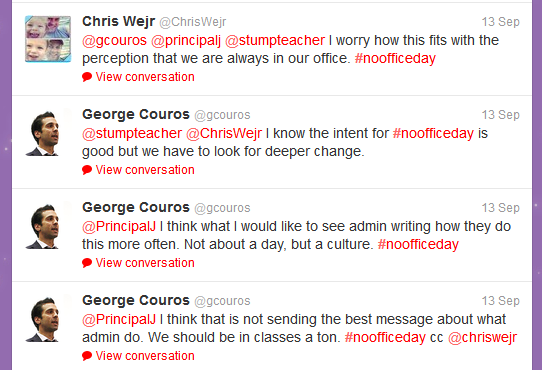
Serious critique deserves serious response. When several educators we respect wondered aloud on twitter about whether No Office Day sends a poor message about administrators, we took their reservations seriously.


Upon further reflections, we still love #NoOfficeDay. For those not yet familiar with No Office Day, it is a day (or numerous days) on which principals and other school leaders shut our offices down and spend the entire day where learning happens - among our teachers and our students. Here are some of the original #NoOfficeDay principal posts that inspired the rest of us: No Office Day by David Truss, Be There by Lyn Hilt and International No Office Day by David Truss.

 
Does No Office Day mean we never spend other time out of our office?  Of course not!  Effective principals are typically hard to find in their offices, because they are the “lead learners” of their building and are usually already in classrooms to observe learning.  #NoOfficeDay days are part of more comprehensive approaches by principals to transform our roles from “experts” directing teachers and managing to full participants in learning, focusing the school on a culture of collaboration to support student learning.  It is a day or several days in which principals immerse themselves into teaching in specific grade levels, certain subjects or throughout the building.  It is time for principals to keep “in touch” with teaching and learning.  

No Office Day is merely one section of a more nuanced tapestry of the role of the principal and the way in which principals and other school leaders engage in learning. We each spend significant time daily in classrooms, not merely “driving by” as walkthroughs have been appropriately critiqued, but reshaping our roles to be more like coaches than evaluators.

It is important to note that while we are out and about all the time many principals still end up spending large amounts of time in the office.  Discipline referrals, parent meetings, scheduling, community partnerships, paperwork,etc.  Some of these efforts are not “busywork” such as meeting with teachers on their own goals and learning and partnering with parents to support their children. Still, it’s unfortunate but its the truth, and we’d be lying if we said we never got caught up in “busywork”.  In some districts, it is more the norm for seasoned administrators to stay in their office and fill the role of manager as compared to instructional leader.  No Office Day allows  the opportunity to light a fire under some of these principals (and central office staff) who haven’t taught a day since leaving the classroom for administration.

We can find No Office Day as more of a celebration of the great things we are doing (coaching, teaching, leading).  Celebrating these things motivates those around us who may be set in their ways and have forgotten what it’s like to be in the trenches.  It’s sad that that’s the case but its true.  Last year all the principals and central office staff (including superintendent) got involved and they had a blasts.  It really changed some of the mindset of our administrators and resulting in regular No Office Days the rest of the year.  

While educators that are not principals, may be critical of #NoOfficeDay, we realize that it is sometimes difficult for teachers to understand all the responsibilities that principals take on day to day.  None of us realized how tough administrators have it...until we became one!


Want to read more from other principals on #NoOfficeDay?  You can find their posts here. 

Edited to add: This is also posted at Connected Principals and has invited great discussion in the comments.  

Saturday, September 15, 2012

Common Core for the Principals


The September/October issue of the Principal journal from NAESP is filled with articles on the Common Core State Standards for Principals.  As the lead learners in our buildings, it is critical that we are leading our faculty into this new era of teaching with the Common Core State Standards.  Although we do not have to fully implement them until the 2014/2015 school year, there is no time to wait. You must be doing work in your buildings on the Common Core State Standards now.

Want to know what we've done in my district with the Common Core State Standards?  You can read about it in this article from Principal. 

Saturday, September 8, 2012

Video clips for staff meetings

I love finding ways to use humorous/inspiring video clips for staff meetings or PD sessions.  They are such a nice way to get started on a positive note, to "lighten the mood" if needed, or to give visual to the message you are wanting to share. Twitter has been a great place to gather ideas from others.  My colleague, Curt Rees, has shared 2 blog posts of video clips he's used:
Good humorous videos for staff meetings
More videos to use with school staff

This post is a bit of a "copy cat" from Curt's posts, but I wanted to share the video clips that I used to start the school year with faculty and tell how/why I used them.

I used this video in both my teachers and support staff meetings:

My message along with this video was, "I think each of your jobs can feel a lot like this with everything you have to do.  If you are ever having a bad day and feel like there are just too many balls to hit, please go back to the Positive Pledge...and let me know how I can help you."

I used this video at the start of our staff meeting during the first week of school:


My message to go along with this video is that I know we have a lot going on this year; a new math curriuclum, a new evaluation model and iPads and I want everyone to know that it's ok to ask questions...even if your question feels as silly as when the man asks how to open the book!

This isn't for humor, but I did share this video clip when reminding teachers that at the start of the school year you cannot assume your students know how to do anything--you have to teach/practice all of the procedures (i.e. sharpening pencils, lining up, walking in the hall, etc.)

I also used this video clip when I briefly shared about some of my learning from John Hattie's book Visible Learning for Teachers and for teachers to "Know Thy Impact."

Here's a video clip I did use for humor (although it was at the end of last year). We were working on common core math practices and I used this Big Bang Theory clip just to lighten the mood (we have many Big Bang Theory fans in our building). It does use the math term "algorithm"!


Monday, September 3, 2012

Ready for the First Day of Bucket Filling!

I'm ready for the first day of school tomorrow and excited to kick off our Bucket Fillers theme for the year.  Here's my blog post in pictures for you (because I'm short on time)...

As students come to the doors they will see...


Our main hallway bulletin board:


This explains the bulletin board:


Here's another Bucket Filler's bulletin board (put together by our wonderful Counselor!):


My bag is packed and ready to go into classrooms to introduce Bucket Filling:


What's in my bag, you ask?  I've got the Bucket Filler's Pledge:


The book I'm reading to the classes:


A variety of books to give to the classrooms (depends on the grade level):


"Drops" to explain how students can fill buckets on our main bulletin board. I will have them write out something to someone in their home to fill their buckets at the end of the day.


I also have this letter for students to take home, explaining Bucket Filling to their parents.

And I also have a bucket full of bracelets for students to choose from. Each one says, "Have you filled a bucket today?"


I can't forget about staff.  I have finally put some of my Pinterest pins to use in the staff lounge: